The data behind the article
Most people who want to lead don’t want the room.
These are the quiz answers cited in Stop using the manager job as a pay rise. Through 29 October 2026, 9,636 quiz completions said they usually coordinate and guide, or take charge directly, in group work. Here is how they answered a question about parties and a question about conflict.
- 57.0%of would-be leaders would spend a party in a quiet corner or with one or two people
- 7.7%would start a group activity
- 13.8%would assert authority when conflict arises
Who counts as a would-be leader
The quiz asks In group work, you usually:
with four answers. We call people who chose Coordinate and guide or Take charge directly would-be leaders. People who chose Support quietly or Give ideas but don’t lead are the supporters, shown for comparison.
Each person sees 20 of the quiz’s 24 questions, so the counts below include only completions that answered both questions in a chart. That is why the two charts have slightly different totals.
Graphic 2 in the article
57.0% of would-be leaders would rather have a quiet party
Exact question: At a party, you’re most likely:
- Stay in a quiet corner
- Chat with 1–2 people
- Mingle with everyone
- Start a group activity
The two quieter answers combined: 57.0% of would-be leaders and 75.2% of supporters. Only 7.7% of would-be leaders would start a group activity.
19,304 completions answered both this question and the group-work question. Bars run from 0 to 100%. Shares are rounded to one decimal place, so a group can add up to 99.9% or 100.1%. Data through 29 October 2026.
Download this chart as PNG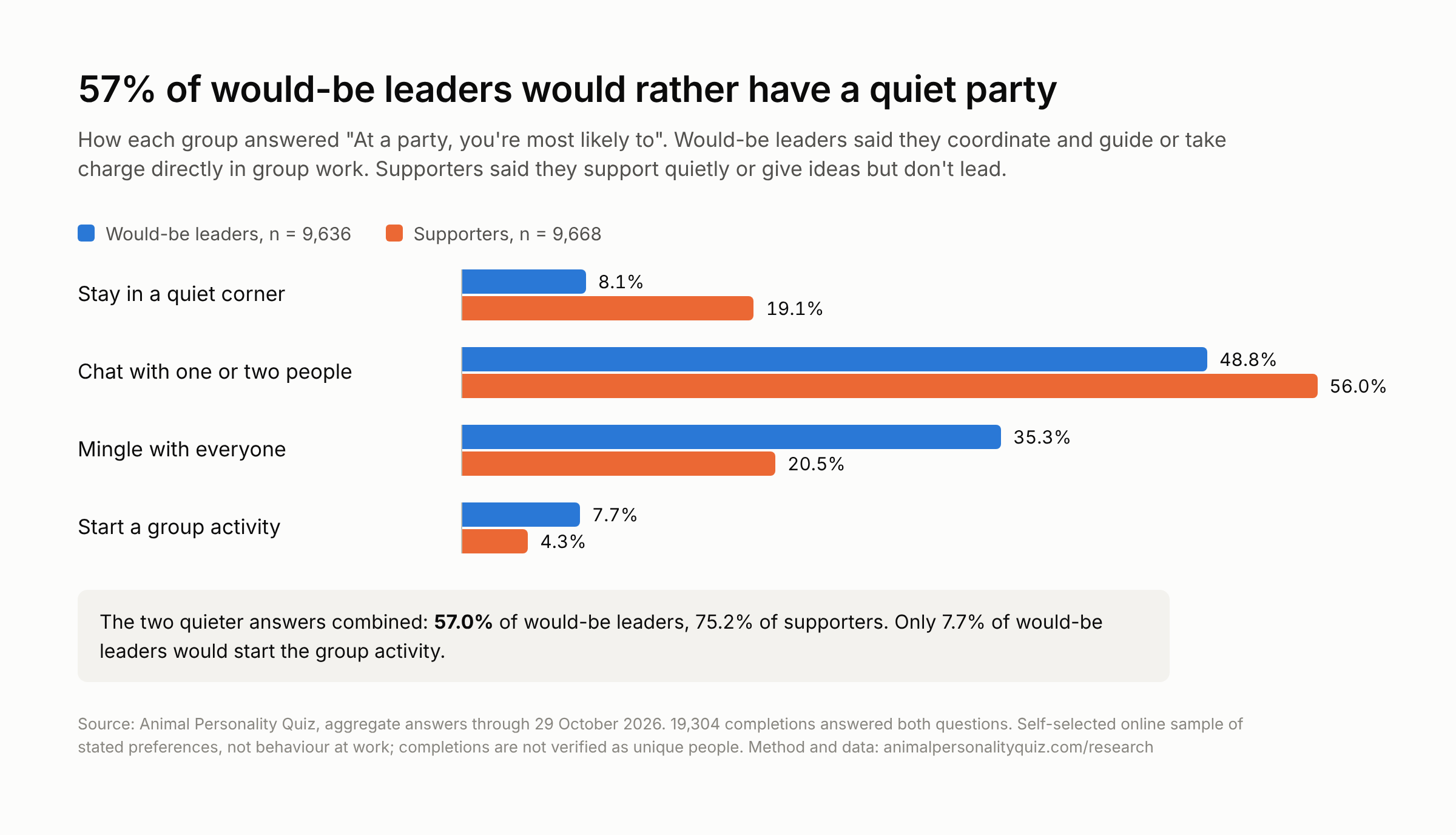
Graphic 3 in the article
13.8% of would-be leaders would assert authority in a conflict
Exact question: When conflict arises:
- Assert authority
- Step up to resolve
- Step back and listen
- Mediate calmly
Among people who said they take charge directly, 20.8% (about one in five) would assert authority. Across everyone who answered the conflict question, it was 11.3%.
19,023 completions answered both this question and the group-work question. Bars run from 0 to 100%. Shares are rounded to one decimal place, so a group can add up to 99.9% or 100.1%. Data through 29 October 2026.
Download this chart as PNG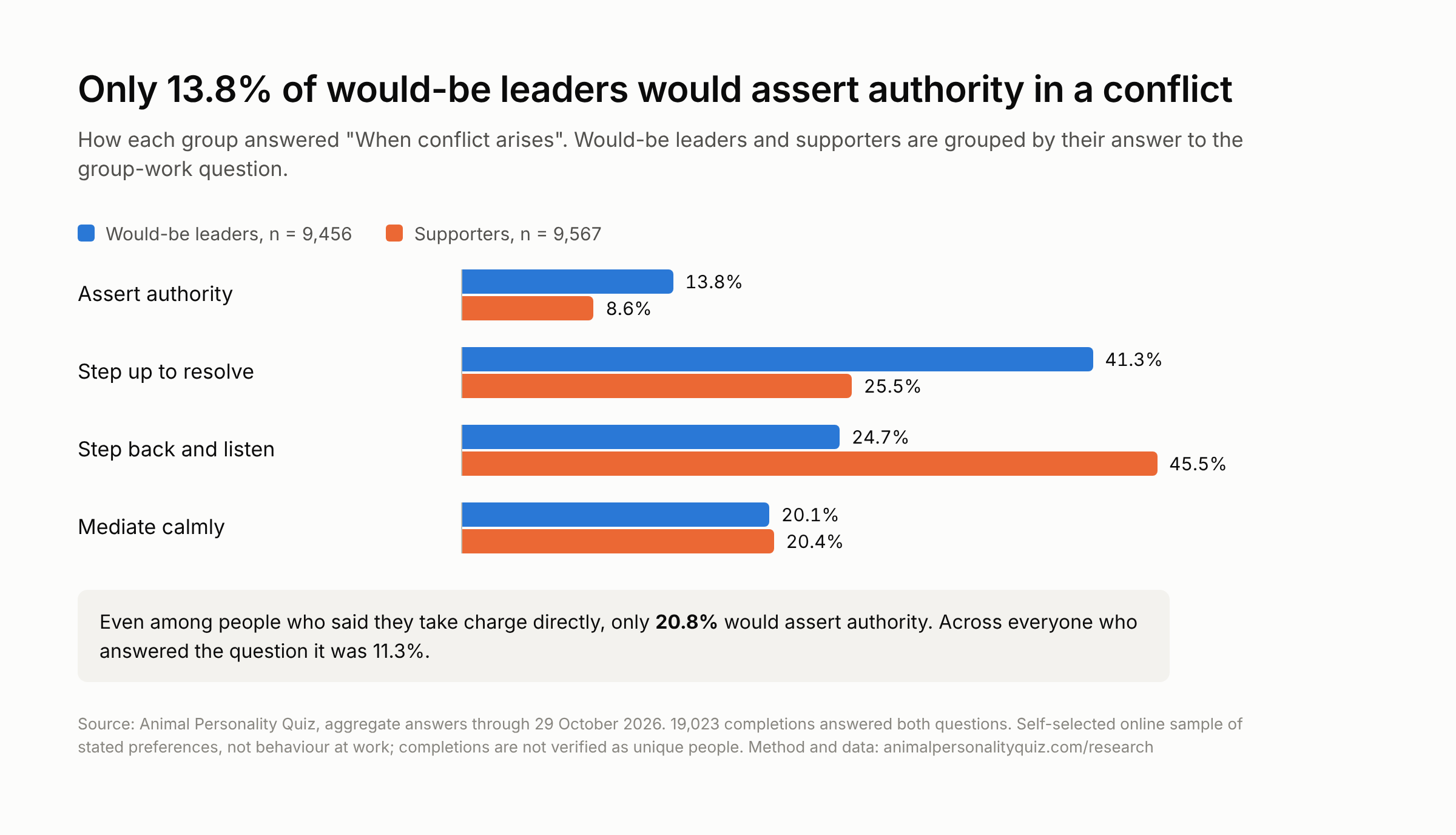
What this data can and can’t tell you
People chose to take this quiz online, from all over the world, so they stand for no workforce. They described imagined situations, not behaviour at work. One person could finish it twice. It isn’t a validated instrument, and two answers side by side don’t show cause. It can’t tell you who your company promotes, and liking to coordinate a group project isn’t the same as wanting to manage people.
These numbers are fixed at 29 October 2026 so they match the article. Our quiet leadership fieldnote shows the party comparison with data refreshed daily, so its figures move a little as new answers arrive. The method page explains which completions count and links the full aggregate tables, including the group-work and conflict pairs.
Other sources in the article
The sales promotion figures (Graphic 1) come from Alan Benson, Danielle Li and Kelly Shue, “Promotions and the Peter Principle”, NBER Working Paper 24343, published in the Quarterly Journal of Economics in 2019. They are not quiz data.
You may reuse these charts. Please credit Animal Personality Quiz, link to this page, and describe the sample as voluntary quiz completions through 29 October 2026.
Would you take the quiet corner or the room?
Take the free quiz