Fast Workers, Slow Mornings
A quiet first hour does not contradict a fast working style. What our quiz data suggests, and three ways to meet the morning as a practice rather than a productivity hack.
Look for advice about mornings and most of what comes back is engineering. Wake earlier. Stack your habits. Win the morning so you can win the day. The first hour is treated like a launchpad: something to optimise so that everything after it goes faster.
There is nothing wrong with wanting a good day. But when the morning becomes a tool for output, it quietly stops being a morning. It becomes the first shift.
Mindfulness offers another way to look at that hour: not as a lever to pull, but as time to be present for. Some numbers I have been looking at suggest that many people, including those who love to work fast, may already want something like that.
What people say they want
At Animal Personality Quiz, I look after the data from our online quiz about everyday preferences. Two of the questions matter here: the pace someone likes to work at, and the kind of start to the day they enjoy most.
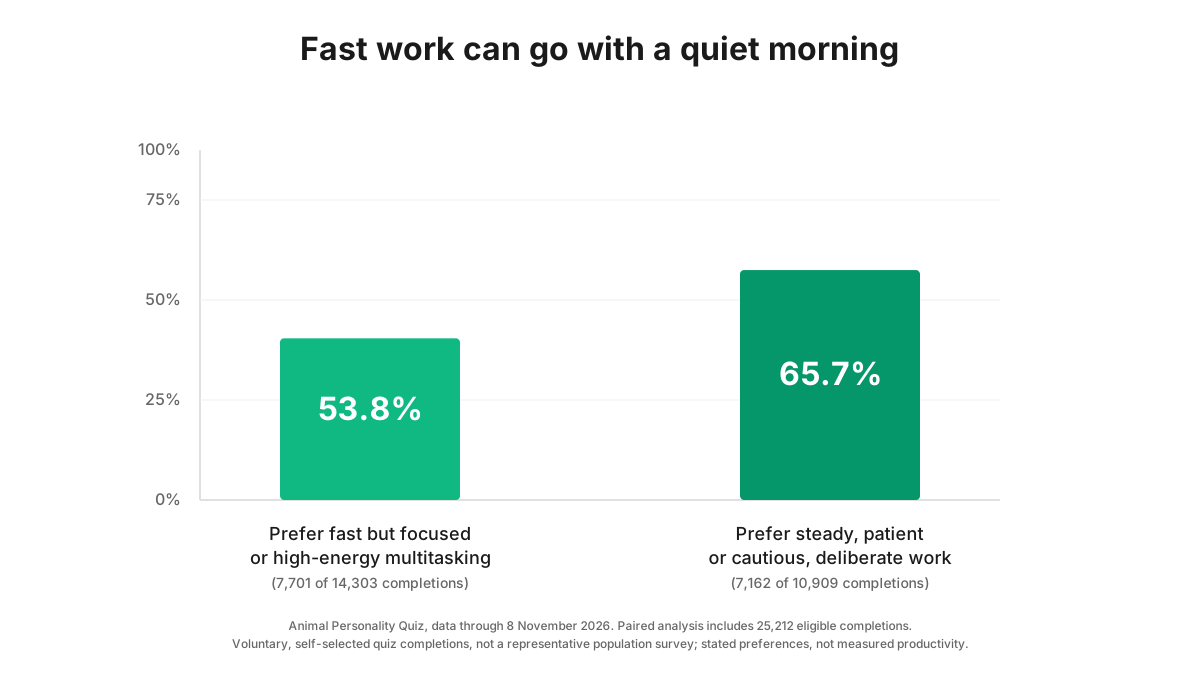
In our research on quiet mornings and faster work preferences, 14,303 quiz completions came from those who prefer fast but focused work or high-energy multitasking. Of those, 53.8% (7,701) picked a quiet, slow morning. That was by far the most common answer. Light activity came next at 20.3%, then exercise or a busy start at 14.9%. Only 11.0% chose the morning where they are already doing three things at once. Among those who prefer steady, patient or cautious, deliberate work, the quiet-morning share was 65.7% (7,162 of 10,909).
These figures need careful handling. They come from a voluntary, self-selected global online sample, not a representative survey. They are stated preferences, not records of how anyone actually spends their mornings. Completions are not verified as unique people. And two answers appearing together shows nothing about cause: the data cannot say that slow mornings help anyone work well, or the other way round. In total, 25,212 eligible completions included an answer to both questions; these figures use the data through 8 November 2026. The quiz did not measure productivity, sleep, wake-up time or chronotype. A preferred work pace is not a performance score.
Still, the wish for a slow start does not seem to belong only to slow-paced people. It is also the most common choice among those who like speed.
The hack and the practice
From the outside, treating the first hour as a hack and treating it as a practice can look identical. Two people can sit by the same window in silence at seven in the morning.
For the first, the silence is an input. It is there to produce something later: sharper focus, a better meeting, more done by noon. If the payoff does not come, the silence has failed. The sitting is a means to an end.
For the second, the silence is the point. The attention given to the light on the glass, the sound of the street, the feeling of sitting before the day begins, is complete in itself. Whatever happens later is welcome, but it is not the reason.
Many contemplative traditions describe practice this way. You do not sit in order to get somewhere else. You sit in order to be where you are. Turn the morning into a performance metric and the logic of the working day has crept into the one part of it that might have been free.
Why fast workers might feel this keenly
The data cannot explain why so many people who prefer fast work still want a quiet morning. But the contrast is worth sitting with.
If your working hours are full of movement, deadlines and switching between tasks, a slow first hour offers something the rest of the day may not: time that is not measured. There is no inbox count and no progress bar. The hour simply passes, and you are there for it.
Seen this way, a slow morning is not a contradiction of a fast working style. It can sit alongside it, the way a rest sits alongside the notes in a piece of music. The rest is not empty. It is part of the piece.
It also helps to remember that preference is personal. Within the fast-work group, 14.9% preferred exercise or a busy start, and 11.0% preferred already doing three things. A mindful morning does not have to be a silent one. A run or a noisy family breakfast can be met with full attention. Mindfulness is about how you meet the hour, not what the hour contains.
Three ways to make the first hour a practice
These are not rules, and none of them requires waking earlier. They are simply ways to meet the morning with attention rather than an agenda.
1. Arrive before you begin
Before you reach for anything, whether a phone, a light switch or a to-do list, pause long enough to notice that you are here. Three slow breaths is enough. Feel your feet on the floor. Notice what you can hear. You are not trying to produce a particular feeling; you are simply registering that a new day has started and that you are present for its first moments. It puts a little space between sleep and the first task.
2. Let one ordinary task carry your attention
Choose something you already do each morning, such as making coffee, washing your face or watering a plant, and do it with full attention. Notice the weight of the cup, the temperature of the water, the sounds and smells. When your mind races ahead to the day's plans, as it will, gently bring it back to what your hands are doing. Nothing new needs to be added to your morning. The practice lives inside what is already there.
3. Cross the threshold on purpose
At some point the first hour ends and the working day begins. Usually we slide across that line without noticing. Instead, try to mark the moment. Pause briefly before you open the first message or join the first call, and notice the shift: this is where the morning ends. Then work as fast as you like. The aim is not to slow your work down. It is to let the morning be complete before it gives way to everything else.
A morning that is not for anything
It is tempting to end with a promise that your days will go better. I would rather not. The data cannot support it, and a promise would undo the idea. A mindful first hour has its own worth precisely because it is not for anything.
What the numbers do suggest is that you are in good company if you want your mornings slow, however quickly you like to work. In this sample, most of those who like to work at speed said exactly that. Perhaps the invitation is simply to take them, and yourself, at your word, and let the first hour be an hour.
If you are curious about your own everyday preferences, take Animal Personality Quiz. Treat the result as a starting point for reflection, not a measure of ability or a rule for how you should spend your day.
About the author
Peter (Petar Slovic) is the creator of Animal Personality Quiz. He has traveled and worked remotely from 25+ countries, and writes about what everyday preferences do and do not show.

